
Want to move inventory faster without driving up costs? It’s time to talk about cross-docking.
To some, it’s just another supply chain buzzword. To others, it’s a logistics cure-all. The truth? It's a highly practical strategy (if you know how to use it).
In this article, we'll break down everything you need to know about cross-docking – what it is, how it works, and whether it makes sense for your operation. No fluff, just the facts that matter.
So, let's dive right into it ...
Understanding cross-docking (the basics)
Think of cross-docking as the express lane of logistics.
Instead of products chillin’ in your warehouse for weeks (or months), they zip through a specialized facility in less than 24 hours – sometimes in just a few hours.
Here's how it works: Trucks roll up to one side of the facility, unload their cargo, and within hours (or even minutes), that same cargo gets loaded onto different trucks heading to their final destinations. No long-term storage. No extended stays. Just quick sorting (and maybe some consolidation), before getting back on the road.
The cross-docking facility setup
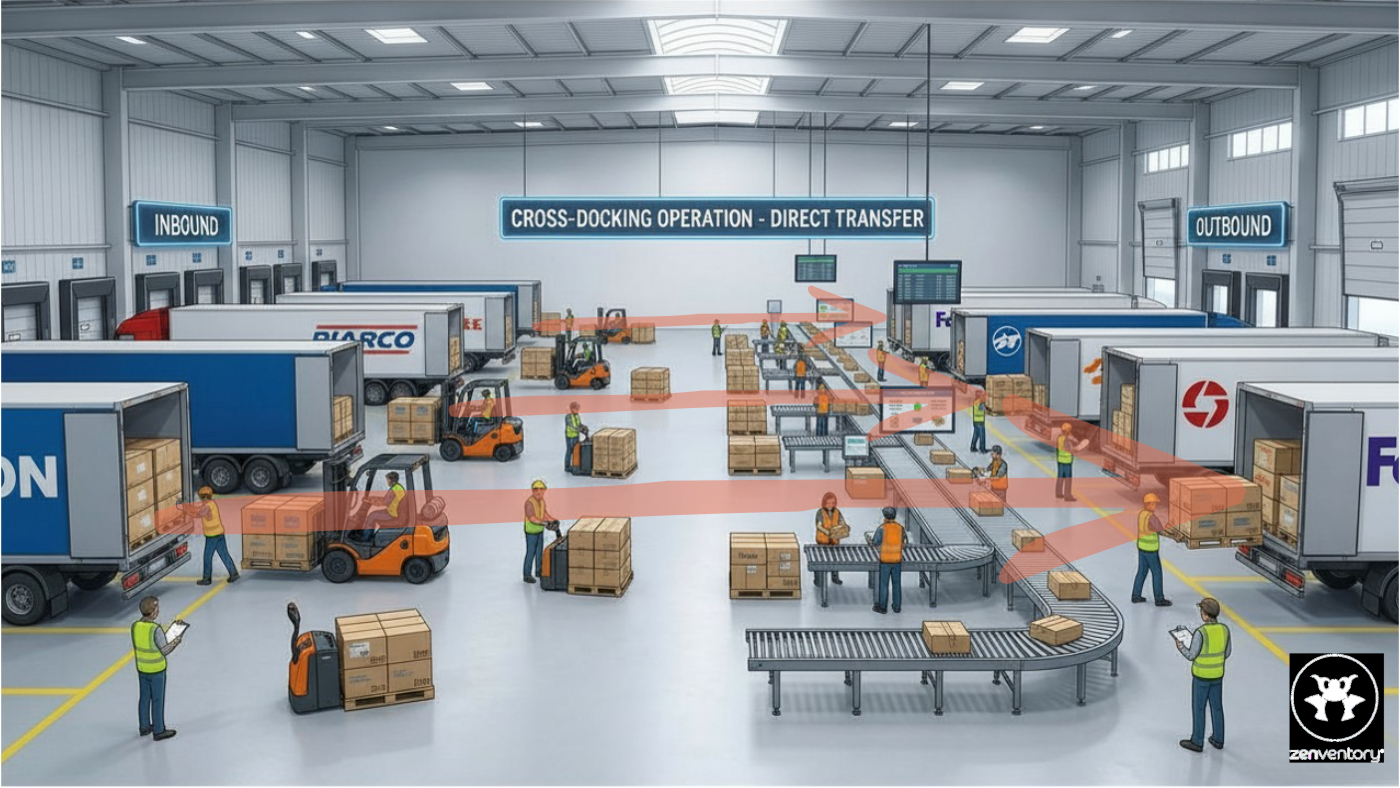
Picture an I-shaped building – that's your typical cross-docking facility. Inbound trucks pull up to dock doors on one side, outbound trucks wait on the other side, and there's minimal storage space in between. The whole setup maximizes efficiency by keeping the distance between receiving and shipping as short as possible.
The name literally describes what happens: Goods cross from the receiving docks to the shipping docks.
But cross-docking isn't just about moving boxes from truck A to truck B. These facilities serve multiple purposes:
- Changing transportation modes: Moving cargo from trucks to trains, or planes to delivery vans
- Sorting by destination: Breaking down large shipments and routing products to different locations
- Consolidation: Combining smaller shipments into full truckloads for better transportation economics
- Deconsolidation: Splitting large shipments into smaller deliveries for final destinations
A bit of history
Cross-docking isn't some newfangled idea. The trucking industry actually pioneered this approach in the 1930s (yep, almost 100 years ago) as a way to improve efficiency. LTL (less-than-truckload) carriers were among the first to master the art of moving cargo from one vehicle to another without extended warehousing.
Smart location matters too. Most cross-docking facilities set up shop near major transportation hubs (think airports, seaports, and highway intersections). This strategic positioning cuts down transit times and makes switching between different transportation modes seamless.
The result? Faster deliveries, lower storage costs, and happier customers.
How cross-docking works
.svg)
Cross-docking = a high-speed relay race for your inventory.
Products arrive, get sorted, and ship out … all within hours. This means that there is no sitting around in storage, no collecting dust on shelves, but just constant movement from point A to point B.
Modern cross-dock operations complete the entire transfer cycle within hours, and in many cases, minutes. The really efficient ones? They're done in under two hours for straightforward transfers.
In short: Speed is everything here.
Receiving
Everything starts when trucks roll up to your inbound docks. Drivers check in, get their dock assignments, and the clock starts ticking.
Your receiving team unloads the goods and immediately inspects everything – quantity, quality, the whole nine yards. They're checking against the paperwork to make sure what arrived is actually what was supposed to arrive.
This inspection step isn't just busy work. It's especially critical when you're dealing with perishables that have limited shelf life. It’s better to catch problems now than deal with bigger headaches later.
The receiving phase sets the tone for everything else. Get it right here, and the rest flows smoothly.
Sorting and handling

Once goods pass inspection, they move into the sorting phase. This is where facilities use barcodes or warehouse management software to track and group items. The sorting criteria depend on your operation. This could be delivery route, product type, customer specs, or final destination.
Here's what might happen during this phase:
- Sorting items by geographic delivery route or final location
- Consolidating smaller shipments into single loads for transportation efficiency
- Deconsolidating larger shipments into smaller units for different destinations
- Repackaging or relabeling products according to customer specifications
Sorted goods move to staging areas where they hang out with other shipments heading the same direction. But "hang out" is relative because we're talking minutes, not hours here.
Warehouse management systems keep everything moving during this phase, providing real-time tracking to prevent delays.
Pallets might get rebuilt or consolidated, with freight sorted by lane, destination, or specific customer requirements.
Dispatch
Transport vehicles get their loading assignments based on route schedules, destination priorities, and when carriers are supposed to show up. Speed and precision matter here.
Typical cross-dock facilities handle multiple dispatch rounds per day for fast-moving consumer goods or time-sensitive freight. Outbound trucks leave according to predetermined schedules that sync with inbound arrival times – keeping that continuous flow that makes cross-docking work.
The whole point? Keep freight moving while touching it as little as possible.
Products spend minimal time in the facility, going straight from receiving docks to shipping docks without any detours into storage areas.
Types of cross-docking
Not all cross-docking operations work the same way. Different businesses have different needs, and timing plays a huge role in determining which approach makes the most sense.
The main distinction? When you decide where products are going.
Cross-docking operations fall into distinct categories based on timing decisions and handling processes. The primary classification separates pre-distribution and post-distribution approaches, determined by when products receive their final destination assignments.
Pre-distribution cross-docking:
The "plan ahead" approach
Pre-distribution cross-docking designates the final destination before goods arrive at the cross dock facility. Products undergo unloading, sorting, and reloading according to predetermined distribution instructions, with suppliers identifying specific customers or locations prior to shipping.
Think of it this way: Before anything even shows up at your dock, you already know exactly where it's going. This method minimizes storage duration at the cross-docking warehouse, as destination information reaches facility staff before suppliers dispatch products.
Retailers operating their own warehouses and maintaining direct oversight of supplier and customer relationships typically employ this approach. The predetermined nature accelerates throughput, with products spending minimal time at the facility compared to alternative methods.
Post-distribution cross-docking:
The "see what shows up" approach
Sometimes you need to see what shows up before you decide where it goes.
Post-distribution cross-docking determines final destinations after products reach the facility.
Goods undergo storage at the terminal while awaiting destination assignments based on demand analysis, inventory levels, and sales projections.
This approach gives suppliers more wiggle room to evaluate shipping decisions, accommodating fluctuating demand patterns and market conditions. The method requires sophisticated sorting operations and technologies to manage real-time allocation decisions.
Distributors and retailers utilizing demand forecasting, seasonality factors, weather conditions, and consumer preference data benefit from this flexibility. Products may remain at the cross docking warehouse longer than with pre-distribution methods, yet the extended timeframe enables more informed distribution choices.
Continuous cross-docking:
The fastest approach
Continuous cross-docking transfers goods directly from inbound to outbound transportation with minimal storage time. Products flow continuously through the facility, moving immediately from receiving trucks to departing vehicles without intermediate holding periods.
This method suits high-demand products requiring rapid replenishment, particularly fast-moving consumer goods and perishable items. But it demands precise coordination among suppliers, carriers, and facility operators. Multiple trucks arrive at designated dock doors, unload cargo, and reload onto vehicles positioned at opposite docks in sequential fashion.
Transportation vehicles arriving at different intervals may experience waiting periods, though the method maintains the shortest overall processing times.
Consolidation cross-docking:
The "combine smaller shipments" approach
Sometimes smaller shipments make more sense when they're combined.
Consolidation cross-docking combines multiple smaller shipments into single, larger loads before transportation. Incoming freight merges with other goods at the terminal to form full truckload shipments, reducing per-unit shipping costs compared to dispatching numerous partial loads.
Products require temporary storage at the facility until sufficient volume accumulates for complete truckload departure. Less-than-truckload carriers and international freight forwarders frequently employ this method, with the latter consolidating multiple loads into single shipping containers for overseas transport. The cost reduction benefits offset extended storage durations, making consolidation arrangements financially advantageous despite delayed shipping schedules.
Deconslidation cross-docking:
The "breaking big shipments into smaller ones" approach
This approach does the opposite – breaking big shipments into smaller ones.
Deconsolidation cross-docking divides large incoming shipments into smaller, separate loads for distribution. This method reverses the consolidation process, with facilities receiving full shipments from suppliers or production centers, then separating and relabeling products into new unit loads.
The approach accelerates delivery to multiple destinations, particularly in direct-to-consumer fulfillment where goods ship to individual customer addresses. Parcel carriers transport products across regions in consolidated shipments before splitting them into smaller batches for final delivery. Retail distribution centers receive bulk supplier shipments and divide them into store-specific quantities based on location-specific demand.
Why businesses are getting excited about cross-docking
So what's the big deal? Why are companies making the switch?
Here's some benefits that actually matter for your bottom line ...
Cost savings that add up fast
Here's where cross-docking gets interesting – businesses implementing this strategy reduce inventory holding costs by up to 50% compared to traditional warehousing. That's not pocket change we're talking about.
Storage expenses drop significantly because products spend minimal time in your facility. Think about it – less warehouse space means lower costs for rent, utilities, security, and insurance. Companies avoid those massive capital investments in huge warehouse facilities and eliminate long-term storage headaches.
The labor savings are real, too. Cross-docking cuts labor expenses by up to 30% by eliminating the back-and-forth of traditional warehousing. Your team isn't constantly picking items from storage or managing inventory moves. The streamlined process reduces touchpoints by up to 70% – that's efficiency you can actually measure.
Speed that customers notice
Want to impress your customers? Organizations achieve delivery lead time reductions of approximately 40% by moving products directly from inbound to outbound transportation. Some operations cut their order-to-delivery cycles from 72 hours down to just 24 hours.
This speed advantage becomes critical for perishable goods where every hour counts. Instead of maintaining stockpiled inventory, businesses can fulfill orders almost immediately, making their entire distribution network more responsive.
Transportation economics that make sense
Here's where the math gets interesting. Converting multiple less-than-truckload deliveries into full truckload shipments reduces transportation expenses by 15-20% while cutting fuel consumption and emissions. Your trucks run fuller, routes get optimized, and you need fewer vehicles overall.
Quality protection
Fewer touchpoints mean fewer opportunities for damage. Operations typically see a 20% reduction in damaged products. This matters especially for fragile or perishable items where expedited movement maintains quality and extends shelf life. Products reach customers in better condition, reducing spoilage and costly replacements.
Visibility you can count on
Cross-docking provides enhanced inventory visibility through real-time tracking systems. Every item gets logged from facility entry to outbound shipment, creating complete product flows you can trace.
The environmental benefits are a nice bonus – reduced energy usage and lower carbon emissions from streamlined operations. Plus, you get more agile inventory management with less risk of excess stock and markdowns.
Faster, more accurate deliveries directly impact customer satisfaction by eliminating storage delays and maintaining consistent performance.
Not bad, right?
Cross-docking challenges
(the ones nobody talks about)
Cross-docking sounds great on paper, but let's be real ... it's not all smooth sailing.
The biggest challenge? Everything has to work perfectly, all the time.
Your suppliers need to deliver exactly when they say they will. Your trucks need to show up on schedule. Your staff needs to move fast without making mistakes. One hiccup in this chain and the whole operation falls apart.
Weather delays? Supply chain disruption? A truck breaks down?
Your cross-dock operation feels it immediately.
Product compatibility issues
Here's what they don't tell you upfront: Not every product works well with cross-docking.
Items that need quality inspections, custom packaging, or special handling? They're going to slow you down. High-value electronics that need careful handling don't mix well with the "move fast, break nothing" mentality of cross-docking.
And if you've got products with unpredictable demand patterns, you're in trouble. Cross-docking works best when you know exactly where everything needs to go before it arrives.
The money factor
Cross-docking requires serious upfront investment.
Initial investment proves substantial, and we're not just talking about a few thousand dollars here. You'll need specialized facilities, automated sorting systems, real-time tracking technology, and warehouse management software that can handle the complexity.
Small and medium businesses often get sticker shock when they see what it actually costs to implement properly.
The technology dependence is real, too. When your systems go down (and they will), your entire operation stops. That's a risk many businesses underestimate.
No room for mistakes
Once products enter your cross-dock facility, there's no going back.
No time for order changes. No opportunity to repackage if something's wrong. No second chances if items get mislabeled or sent to the wrong truck.
Speed creates pressure, and pressure creates mistakes. The faster you try to move things, the higher the chance something goes wrong.
Transportation headaches
Ironically, cross-docking often means more transportation, not less.
You'll need more frequent shipments and potentially larger fleets to keep everything moving. More trucks mean higher fuel costs, more driver wages, and more complex scheduling.
If you're in an area with limited transportation options or longer delivery distances, this model might actually cost you more than traditional warehousing.
Higher handling risks
Fast-paced environments are tough on products.
When your team is rushing to meet tight deadlines, things get damaged. Items get mislabeled. Products sometimes go missing.
This is especially problematic if you're dealing with fragile items, electronics, or anything that requires regulatory compliance. Your staff training needs are also different – everyone needs to be both fast and accurate, which isn't always an easy combination.
The bottom line? Cross-docking can work beautifully, but only if you go in with your eyes wide open about these challenges.
Industries that use cross-docking
Cross-docking isn't a one-size-fits-all solution, but certain industries have figured out how to make it work brilliantly. The common thread? They all need products moving fast while keeping costs down.
Supermarkets are probably the cross-docking champions you see every day. Fresh produce, dairy, and prepared foods can't sit around waiting – they need to get from suppliers to store shelves quickly. The result? Longer shelf life for customers and way less spoilage for retailers. That's a win-win.
Department store chains like Walmart have turned cross-docking into an art form. Walmart actually built their entire competitive advantage around this – unloading supplier trucks at distribution centers and immediately reloading products onto store-bound vehicles. No storage phase, no extra handling costs. Fashion retailers love this approach too because it means the latest trends hit stores faster, and electronics retailers use it to keep up with rapidly changing tech demands.
E-commerce operations have taken cross-docking to the next level. Amazon strategically positions fulfillment centers near suppliers and key markets, making those lightning-fast deliveries possible. Alibaba does something similar across global markets, optimizing distribution networks to reduce transit times. When you're handling millions of daily orders, especially during peak shopping seasons, this approach becomes essential.
Automotive manufacturers integrate cross-docking right into their just-in-time production systems. Parts arrive exactly when needed on the assembly line, eliminating warehousing costs and keeping production flowing smoothly. It's all about synchronization.
Pharmaceutical companies face unique challenges with temperature-sensitive medications and strict regulatory requirements. Cross-docking helps them maintain those critical temperature controls throughout distribution while avoiding costly specialized storage facilities.
Parcel delivery and logistics companies use cross-docking to accelerate package delivery. Consumer packaged goods manufacturers, food and beverage suppliers, health and beauty brands, and home goods distributors all benefit from this approach when shipping into large retail networks.
The pattern here? These industries share tight delivery windows, high volume requirements, and strong cost pressures. Cross-docking helps them address all three.
FAQs
Q1. What does cross-docking mean in logistics?
Cross-docking is a logistics method where products move directly from incoming to outgoing transportation with little to no storage time. Instead of being stored in a warehouse, goods are unloaded from inbound trucks, sorted, and immediately loaded onto outbound vehicles for delivery to their final destinations.
Q2. Why is cross-docking considered a risky operation?
Cross-docking carries risks because products move rapidly through facilities without protective storage periods. The fast-paced environment increases the chances of product damage from rushed handling, mislabeling, misrouting, and potential theft or inventory loss. This proves especially challenging for fragile items, electronics, or high-value goods that require careful handling.
Q3. How much time do products typically spend in a cross-docking facility?
Products usually spend less than 24 hours in a cross-docking terminal, with many operations completing transfers in under two hours. For straightforward transfers, the entire process from receiving to dispatch can take just minutes to a few hours, depending on the complexity of sorting and the volume of products being handled.
Q4. What happens when a shipment is received at a cross-dock?
When products arrive at a cross-dock facility, they are unloaded from inbound trucks, immediately inspected for accuracy and quality, then sorted based on their final destinations. After sorting, the goods are reloaded directly onto outbound vehicles heading to customers or retail locations, bypassing traditional warehouse storage entirely.
Q5. Which industries benefit most from using cross-docking?
Supermarkets and grocery stores use cross-docking for fresh produce and perishables, retail chains like Walmart employ it for cost reduction, e-commerce companies such as Amazon utilize it for faster deliveries, automotive manufacturers integrate it into just-in-time production, and pharmaceutical companies apply it for temperature-sensitive medications requiring rapid distribution.
.png)